

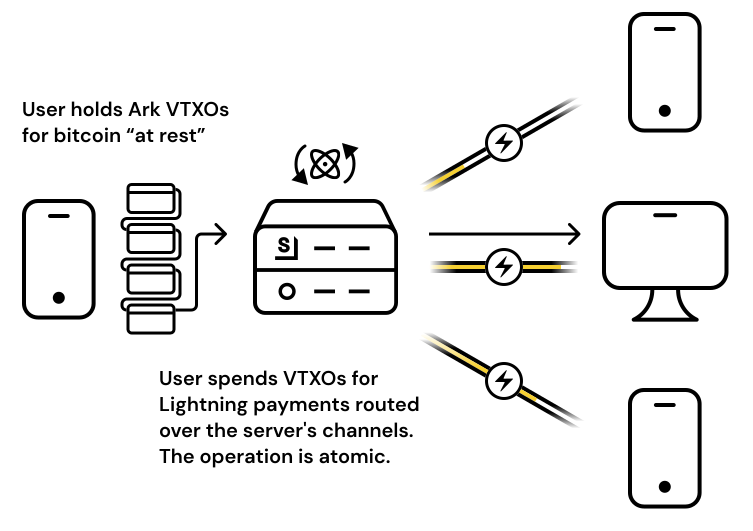

The Ark server acts as a Lightning gateway, handling all channel and routing management for users
Most Bark-based payments will be Lightning paymentsArk payments require both sender and receiver to share the same Ark server. Until individual Ark servers build significant user bases, most payments from Ark wallets will be routed over Lightning—reaching anyone on the network regardless of what wallet app or service they use.
Ark HTLCs
Both outgoing and incoming Lightning payments on Ark use HTLCs (hash time-locked contracts) to ensure atomic execution. An HTLC locks bitcoin with two possible outcomes: it can be claimed by revealing a secret (the preimage), or it returns to the sender after a timeout. HTLCs are integral to how the Lightning Network routes payments across the network.Sending a Lightning payment
When you send a Lightning payment, you spend one of your VTXOs to an HTLC. The Ark server routes the payment to the recipient over the Lightning Network using its own channels. The HTLC serves a similar role to the forfeit used in on-chain payments: it’s an off-chain transaction that the server holds as a safeguard, ensuring you can’t reclaim the VTXO after the payment has been delivered.The send process
- Initiate payment: You provide a Lightning invoice or address to pay.
- Construct HTLC: Your wallet app and the Ark server cooperate to spend one of your VTXOs into an HTLC—a conditional off-chain output that locks the payment amount until the Lightning payment succeeds or fails.
- Route payment: The Ark server routes the payment over the Lightning Network to the recipient.
- Settle: The server obtains the preimage from the Lightning Network and provides it to you as proof of payment.


A Lightning payment's HTLC structure and the revocation path used if a payment fails
Trust model for Lightning send
When a Lightning payment is delivered successfully, none of the HTLC’s spend paths are used. Like a forfeit, the HTLC is held off-chain as a safeguard against malicious exits—the server simply sweeps the round transaction when it expires. The spend paths only come into play when something goes wrong:
The preimage is what makes Lightning sends atomic: it only exists if the Lightning payment was delivered, and without it the server cannot prevent you from reclaiming your bitcoin.
Receiving a Lightning payment
On Bark, you can receive Lightning payments from anyone on the Lightning Network—no channels or inbound liquidity required. The incoming bitcoin is delivered as a VTXO, so bitcoin at rest are always held in VTXOs, not Lightning channel balances.The receive process
- Generate invoice: Your wallet app generates a preimage and payment hash on-device, then sends the hash to the Ark server. The server returns a Lightning invoice for the sender to pay.
- Incoming payment: A sender pays the invoice. The payment routes through the Lightning Network and arrives at the Ark server, secured by the preimage. The server sends your wallet app a notification that a payment has been received.
- HTLC prep: Your wallet app comes online and requests an HTLC from the server. The server constructs the HTLC—funded from its VTXO pool and locked to your preimage—then shares it with your wallet app.
- HTLC claim: Your wallet app verifies the HTLC, then reveals the preimage to the server. The server verifies the preimage and completes the payment via an arkoor transfer. You receive a VTXO.
Trust model for Lightning receive
The receive HTLC has three spend paths, each covering a different scenario:
To fund Lightning receive HTLCs, the server maintains a pool of its own VTXOs. When your wallet app requests an HTLC, the server spends one of these VTXOs into the HTLC, signs it with an ephemeral key—a temporary signing key generated for that specific HTLC—then deletes the key before sharing the signed transaction with you.


A failed claim currently requires a prompt manual exitBark no longer starts emergency exits automatically when a Lightning receive claim fails. If the server doesn’t complete the claim after your wallet app reveals the preimage, Bark retries a few times over the course of a minute or two, then logs a warning and leaves the receive pending. Nothing more happens on its own. Your wallet app has to treat the receive as failed and call
attempt_lightning_receive_exit in the Bark SDK, either automatically once retries are exhausted or through a control it exposes to you.Without the exit, a dishonest server could use the revealed preimage to claim the incoming Lightning payment for itself. It could then take the HTLC’s bitcoin back through the server safeguard once its timelock expires. What matters is the deadline, not the number of retries. The claim can be retried for as long as the HTLC still has enough time left to complete an exit, roughly 180 blocks, and your wallet app should start the exit before that point. In the worst case, an HTLC granted at the minimum allowed expiry leaves only two blocks (about 20 minutes) of slack after the claim first fails.Bark previously started exits on Lightning receive failures automatically, but transient claim failures triggered unnecessary exits, so we disabled the behavior. We are working on making claims more robust, and intend to reinstate the automatic exit once that work has proven itself.Offline receive, online invoice generation
On Bark, Lightning payments can be received when offline. Your wallet app does not need to be online when the sender pays—any HTLC from an inbound Lightning payment is secured by your invoice’s preimage. However, you do need to be online for invoice generation, which is an interactive process with the Ark server, and you do need to come online before the Lightning HTLC expires to claim the payment.Lightning payment fees
Sending
Sending a Lightning payment involves several cost components:- Liquidity costs: The Ark server must deploy bitcoin to route the payment over the Lightning Network. Costs depend on the payment amount and the server’s cost of capital.
- Lightning routing fees: Standard Lightning Network routing fees for the payment’s path through the network.
- Ark server fees: The Ark server may charge additional fees to cover operational costs including Lightning node infrastructure.