


A simplified example of the kind of transaction tree that is produced during a round
Payments now occur out-of-roundEarly Ark protocol proposals included payments within rounds, but this is no longer the case. Second’s implementation of Ark handles all payments instantly through arkoor (out-of-round) transactions. Rounds are now reserved for refreshes only.
What rounds accomplish
Users participate in rounds for two main reasons:- Lifetime management: Refreshing a VTXO that is nearing the end of its lifetime to extend it and maintain control of their bitcoin.
- Security upgrade: Converting spend VTXOs (which have additional trust requirements) into refresh VTXOs with improved security.
Round process
Refreshing requires the wallet app to participate interactively with other users and the Ark server during the round, signing its own branches in the transaction tree. Once the round confirms, the resulting refresh VTXO can be exited unilaterally without relying on any third party.
This requires the wallet app to be online during scheduled round windows, making it suitable for always-on devices like desktops, servers, and nodes.
Delegated refreshes
Due to operating system limitations, some devices—particularly iOS devices—cannot reliably wake for scheduled round windows. Delegated signing addresses this by allowing designated co-signers to sign on the user’s behalf during the round, with the wallet app claiming the new VTXO when the user next opens the app.How delegated signing works
Rather than participating interactively during a round, the wallet app submits refresh intents ahead of time—either when the user opens the app or via a lightweight background wake. Designated co-signers then sign on the user’s behalf during the round.

In a delegated refresh, cosigners sign on the user's behalf. The user collects the signed transactions when they next open their wallet.
Delegated refresh trust model
Delegated refresh VTXOs have reduced security compared to standard refresh VTXOs. Users must trust that at least one designated co-signer behaves honestly—a 1-of-n trust model. Wallet app providers and other entities act as co-signers, each signing the entire transaction tree. Security is additive: each additional co-signer strengthens the trust model for all users, regardless of which app they use. Some wallet apps will predefine a fixed co-signer set (presumably including themselves); others will let advanced users specify their own co-signer set. If a required co-signer is unavailable, the delegated refresh fails and alerts the user. Delegated refresh is entirely opt-in—a practical compromise for mobile OS limitations. With multiple co-signers and a 1-of-n trust model, it offers pretty good security. However, mobile wallet app developers should still consider providing optional alternative paths to standard refreshes, e.g., push notifications that prompt users to open the app before upcoming rounds, or companion desktop/node apps that can refresh on behalf of the mobile wallet.Covenants eliminate the trust requirementIf a covenant proposal (like CTV or TEMPLATEHASH) were adopted on bitcoin, delegated refreshes would become fully trustless.
Round atomicity
Round atomicity is ensured through hash-locked forfeit transactions. The server generates a preimage for each new VTXO and constructs both the new VTXO and the user’s forfeit with a hash-lock condition tied to it. This guarantees that the server cannot claim the old VTXO without also revealing the preimage—which in turn gives the user access to their new VTXO. Either way, the user cannot lose bitcoin.Round timing and interval
Second’s Ark server conducts rounds every hour (round frequency is a server-configurable parameter).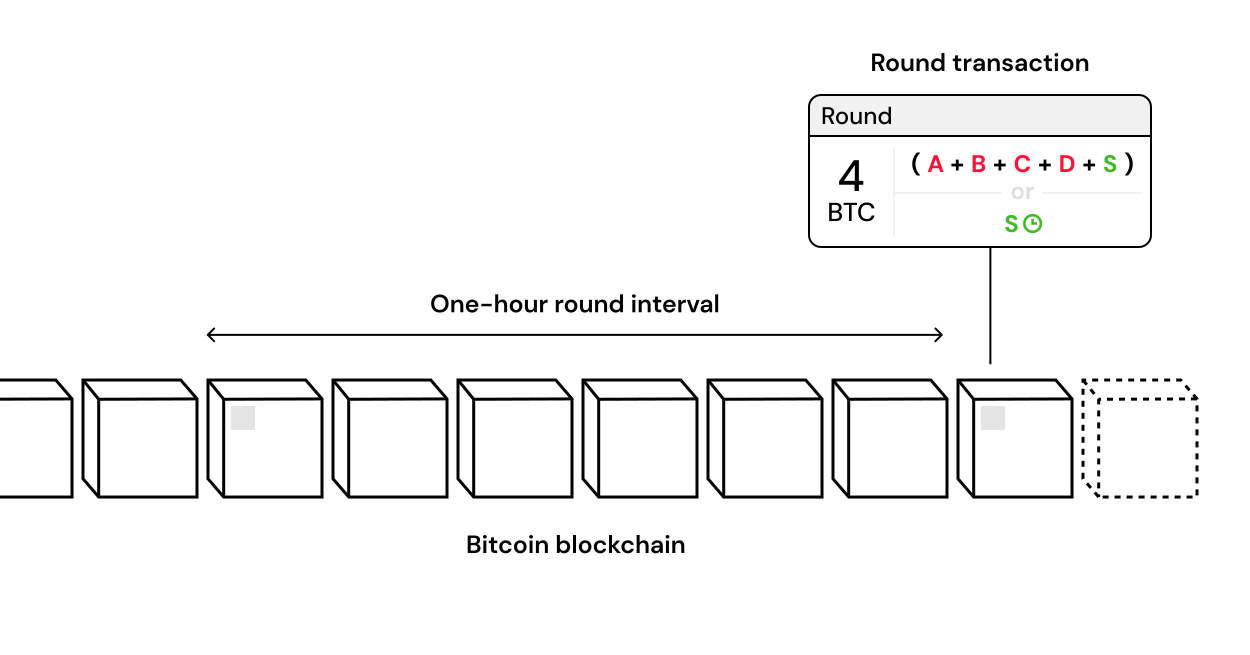

A one-hour round interval results in a round transaction being confirmed roughly every six blocks
Interval length trade-offs
All things being equal, more frequent rounds will inevitably attract fewer participants per round since users are spread across more opportunities to refresh. Conversely, less frequent rounds lead to more participation demand per round. This fundamental relationship drives several important trade-offs:Flexible round schedulingWhile Second’s Ark server uses fixed periodic rounds, servers can technically implement more flexible scheduling:
- Demand-based rounds: Queue thresholds for triggering a round
- Emergency rounds: On-demand rounds for users with soon-to-expire VTXOs
- Scheduled maintenance: Temporary increase in round frequency before planned downtime
Round economics
Executing rounds involves two major costs for an Ark server:- On-chain transaction fee: The cost of getting a round transaction confirmed on-chain, which is spread across all users participating in the round—the more users, the lower the cost per user. Despite the underlying transaction tree requiring an n-of-n multisig potentially involving hundreds of users, the Ark protocol uses Taproot and MuSig to make this complex script appear on-chain as a simple single-signature transaction, minimizing the blockchain footprint.
- Liquidity deployment costs: When users refresh their VTXOs, the Ark server must deploy bitcoin (liquidity) from its wallet to fund the new outputs. The forfeited bitcoin from old VTXOs only becomes available to the server after those VTXOs expire, so there is a cost of capital to cover. This cost is independent of the number of users participating in the round, and is instead dependent on the amount of bitcoin being forfeited and the age of the VTXOs.
Fee schedules for Second’s Ark server are still being finalized, and may not directly reflect the server’s costs for users’ individual operations. You can read more about fee considerations on our fees page.